


SL019 Self-Leadership in a Crazy World
Five challenges of modern leadership—and what to do this week, drawn from my new eBook Lead Yourself in a Crazy World
How protected is your attention—really—against information overload, misinformation, and the next deepfake headline?
Are you partnering with AI consciously—or are you swinging between hype and avoidance?
And when uncertainty, polarization, and pressure rise, do you have routines that keep you grounded and capable of action?
Welcome
Welcome to a new episode of Self-Leadership with Dr. Bensmann—where we explore how mastering self-leadership helps you thrive in all areas of life, especially when the world feels noisy and unstable.
I’m Burkhard Bensmann—consultant, executive coach, and professor. I work with CEOs, entrepreneurs, and public leaders, often in demanding transition situations.
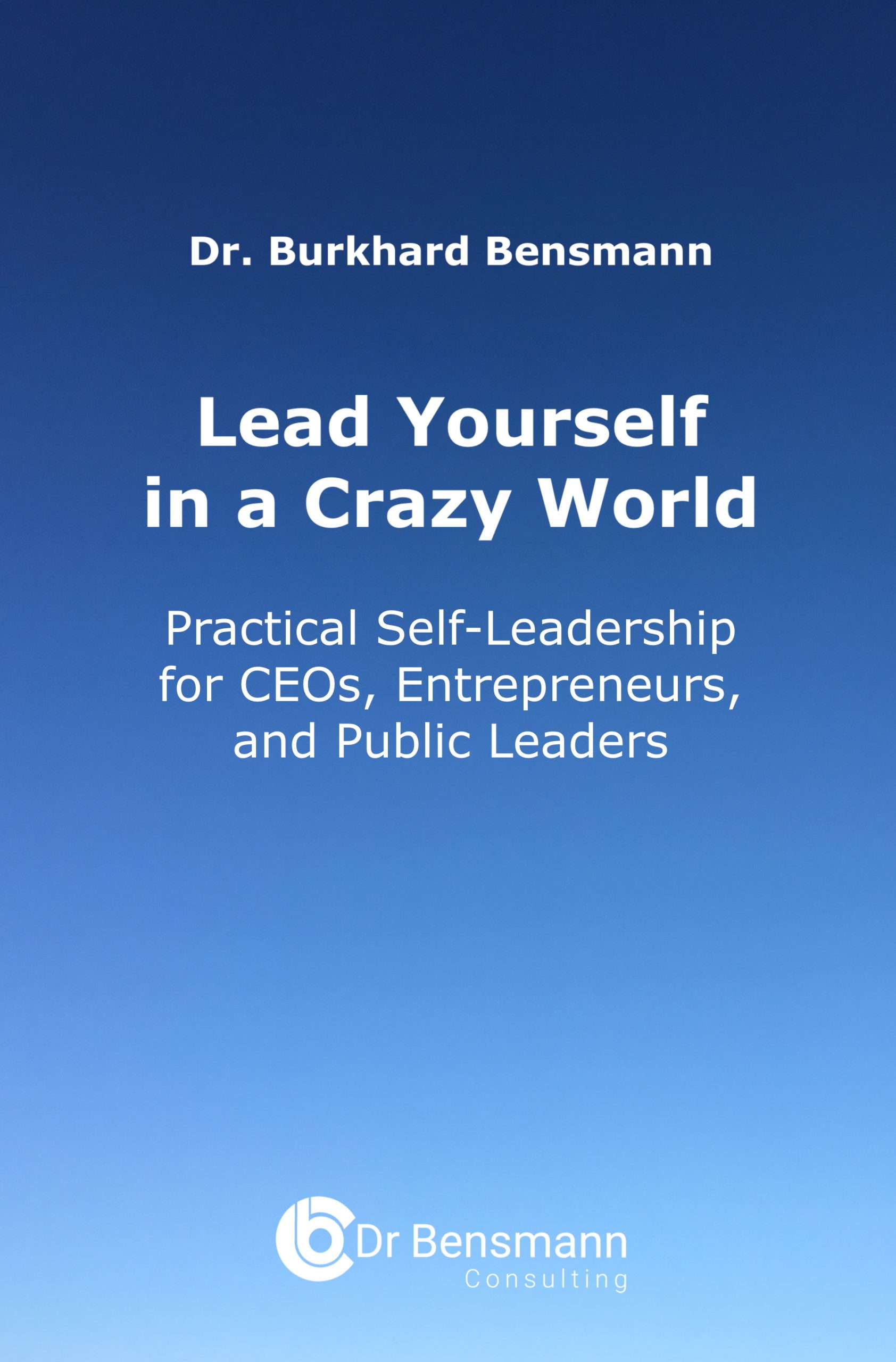
Today’s episode is based on my ebook Lead Yourself in a Crazy World: Practical Self-Leadership for CEOs, Entrepreneurs, and Public Leaders.
The core message of Lead Yourself in a Crazy World is: you can’t control the outer storm—but but you can learn to sail in it.
It’s written for the reality many leaders face right now: acceleration, fragmentation, and unpredictability—and the pressure of being expected to deliver results, stay calm, and still look optimistic while the ground keeps shifting.
In this episode, we’ll move through the book’s core structure: five concrete leadership challenges of our time—plus a compact toolbox and a simple framework: the Seven Fields of Self-Leadership.
As always, this is not theory for theory’s sake—each segment ends with small, practical moves you can test immediately.
Why this book, why now
Many leaders tell me things like: “I go through 200 emails and still feel behind,” or: “Everyone expects me to have an AI strategy, but I barely have time to think.” This world creates a risk that’s subtle: you still function, but you slowly shift from leading to reacting—until you notice you’ve lost your inner direction.
So the premise of this book—and this episode—is simple: self-leadership is no longer a private nice-to-have. It’s a board-level capability for sustainable performance.
And in my work, self-leadership means: attitudes and methods for goal-oriented leadership of oneself—based on self-awareness, self-responsibility, and self-direction.
Let’s walk through the five challenge areas.
1) Protect your mind
The first challenge is information chaos—too much input, too many channels, and a rising uncertainty about what’s real.
The book points out that AI-generated text, images, audio, and video raise the stakes: deepfakes and disinformation campaigns can directly attack trust and decision quality.
The self-leadership move here is to treat attention as a scarce strategic resource—something you actively govern, not something you surrender to your inbox and the news cycle.
The book offers three practical elements: a personal attention framework, a simple trust filter, and short clarity rituals.
Small moves for this week (one-week experiment):
- Fix two email windows per day instead of continuous checking.
- Schedule one 60-minute deep work block per day with notifications off.
- Each evening, write three lines: “What really mattered today?”
Reflection question:
Where is attention leaking most in your day—and what rule would protect it without needing willpower?
2) Partner with the machines
The second challenge: AI is already in everyday work, often before leaders have had time to form a real stance—and at the same time cyber risks evolve quickly.
In the book, this shows up as a common inner triangle: curiosity, anxiety, and overload—often leading either to tech hype or tech denial.
The goal is not to become an AI engineer. The goal is to relate to AI as a leader—consciously.
Three moves are central: clarify your personal AI stance, build a minimal tech cockpit, and treat cyber risk as part of self-leadership hygiene.
Small moves for this week:
- Write a half-page “AI stance” (or personal AI manifest) with three zones: green (active use), yellow (careful experiments), red (no use).
- Define your 3–5 core tools—few tools, used deeply and consistently.
- Agree on a simple verification rule for critical requests (especially unusual urgency or financial instructions).
Reflection question:
Where would a clearer AI boundary reduce stress immediately—without reducing performance?
3) Steady in the storm
Challenge three is the polycrisis: overlapping disruptions—geopolitics, regulation, climate risks, tech shocks—creating permanent instability.
In that environment, many leaders shrink their time horizon and respond with more control, more reporting, more firefighting—while fatigue rises.
The self-leadership focus is keeping an inner compass in unstable conditions.
The book highlights three practices: distinguish concern from influence, use mission/vision/values as living tools, and establish decision routines under uncertainty.
Small moves for this week:
- Map your worries into three columns: concern, direct influence, indirect influence—and review weekly where your time went.
- Write half a page on mission and half a page on a 5–7 year vision; mark what is non-negotiable vs. adaptable.
- Use a one-page decision log: decide, document reasoning, set a review date.
Reflection question:
Which decision are you delaying because you want certainty—when you actually need a routine for “good enough”?
4) Stay grounded in a polarized world
Challenge four: polarization, outrage dynamics, and fragile trust. Leaders can feel that one misstep becomes a public storm, which tempts them into vagueness—or into defensive communication that disconnects them from their own values. The book frames the antidote as inner stability and clarity of stance.
Three supports: define your personal police line (or non-negotiables), train inner distance to outrage dynamics, and practice respectful, clear communication under pressure.
Small moves for this week:
- Pick one issue that deeply matters to you and write 2–3 simple sentences as your stance—internal clarity first, PR later.
- Choose one platform or source you stop checking daily to reduce outrage exposure.
- After tense interactions, review: “Did I stay aligned with my values—what would I adjust next time?”
Reflection question:
Where are you currently “performing leadership” instead of speaking and acting from a clear inner line?
5) Take care of the instrument – yourself
Challenge five is exhaustion and alienation—leaders functioning while slowly losing themselves. The book describes typical drivers: always-on culture, blurred boundaries, continuous crisis mode, permanent evaluation—and rising burnout symptoms.
Here, self-leadership becomes very concrete: treat body, soul, and mind as your core instrument.
The book emphasizes body rhythms, inner narratives and self-efficacy, meaning as “flow between life areas,” and the courage to rest and say no.
Small moves (a four-week rhythm):
- Week 1: Stabilize one body routine (e.g., daily 20-minute walk or fixed weekday bedtime).
- Week 2: Reframe one limiting inner sentence per day into a realistic, learnable version.
- Week 3: Weekly check: which life area is undernourished—and one small action to feed it.
- Week 4: Protect one device-free hour in a quiet place—rest as a precondition, not a reward.
Reflection question:
What would change if rest was treated like strategy—scheduled, protected, and non-negotiable?
Toolbox + the Seven Fields framework
After the five challenges, the book provides a short toolbox—practical tools like drafting your mission, creating a personal vision, a relevance check, a media diet, an “AI radar,” a personal planning day, and a “mental immune system” with micro-practices.
To integrate everything, it introduces the Seven Fields of Self-Leadership: Vision/Mission, Body/Soul/Mind, Competencies/Self-Development, Co-workers/Partners/Networks, Processes/Structures, Projects/Products, and Added Value.
A simple self-check is suggested: once or twice per year, rate each field from 1 to 10, pick two priority areas, and define small concrete actions—then repeat to observe patterns over time.
This turns self-leadership into a renewable practice – a system you revisit and refine.
Hint: You can use the episode SL002 “Control Yourself with the Seven Fields of Self-Leadership” (https://bensmann-consulting.com/sl002-the-seven-fields-of-self-leadership/) as well.
Small move for tomorrow:
- Rate the seven fields quickly (gut feeling is enough), then choose one “smallest next step” for your lowest field.
Closing
You cannot slow down the pace of global change, and you cannot fix deepfakes, geopolitics, or polarization on your own. So take one sober step: analyze what you can change—and what you cannot—and then focus your energy on the few things that are truly within your power. You can protect your attention, clarify your mission and stance, partner with technology consciously, care for your instrument, and build structures that support what matters—this is self-leadership in a crazy world.
If you want to dig deeper, use the book Lead Yourself in a Crazy World as a practical guide—and pick the chapter that matches your current pressure point.
This was today’s episode of Self-Leadership with Dr. Bensmann.
Before you move on, write down one small step you will actually take this week—just one—and schedule it.
The New Compact Book
Purchase
as ebook
or print version here.
Music Intro & Outro by Joakim Karud http://soundcloud.com/joakimkarud


