


SL018 Focus Instead of Constant Stress
Self-Leadership in the Age of AI: How Top Executives Can Protect Their Attention
How often do you start your day already in reaction mode—before you’ve even worked on your most important topics?
Which information around you is truly reliable—and what is simply loud, emotional, or manipulative?
And: Are you already using AI as a productive partner—or is it mainly creating additional pressure because everyone expects you to have “a clear AI strategy”?
Welcome to a new episode of Self-Leadership with Dr. Bensmann, where we explore how mastering self-leadership helps you thrive in all areas of our life.
I’m Burkhard Bensmann—a consultant, executive coach, and professor. I work with entrepreneurial people in Germany and abroad, mostly in demanding transition situations.
As an executive coach and consultant, I’ve been working very intensively on the topic of AI for the past two years. One element of my coaching system is: AI impulses for CEOs, owners, and managing directors. AI is both a blessing and a curse—and we have to learn how to make it work for us. AI should help us focus and keep the essential things in view.
That’s why today’s episode is about a core question of effective leadership: How do you lead yourself when the information stream never ends, when AI increases the speed—and at the same time the risks of disinformation and deepfakes grow?
In this episode, I’ll take you on a practical walk-through of three building blocks—with reflection questions.
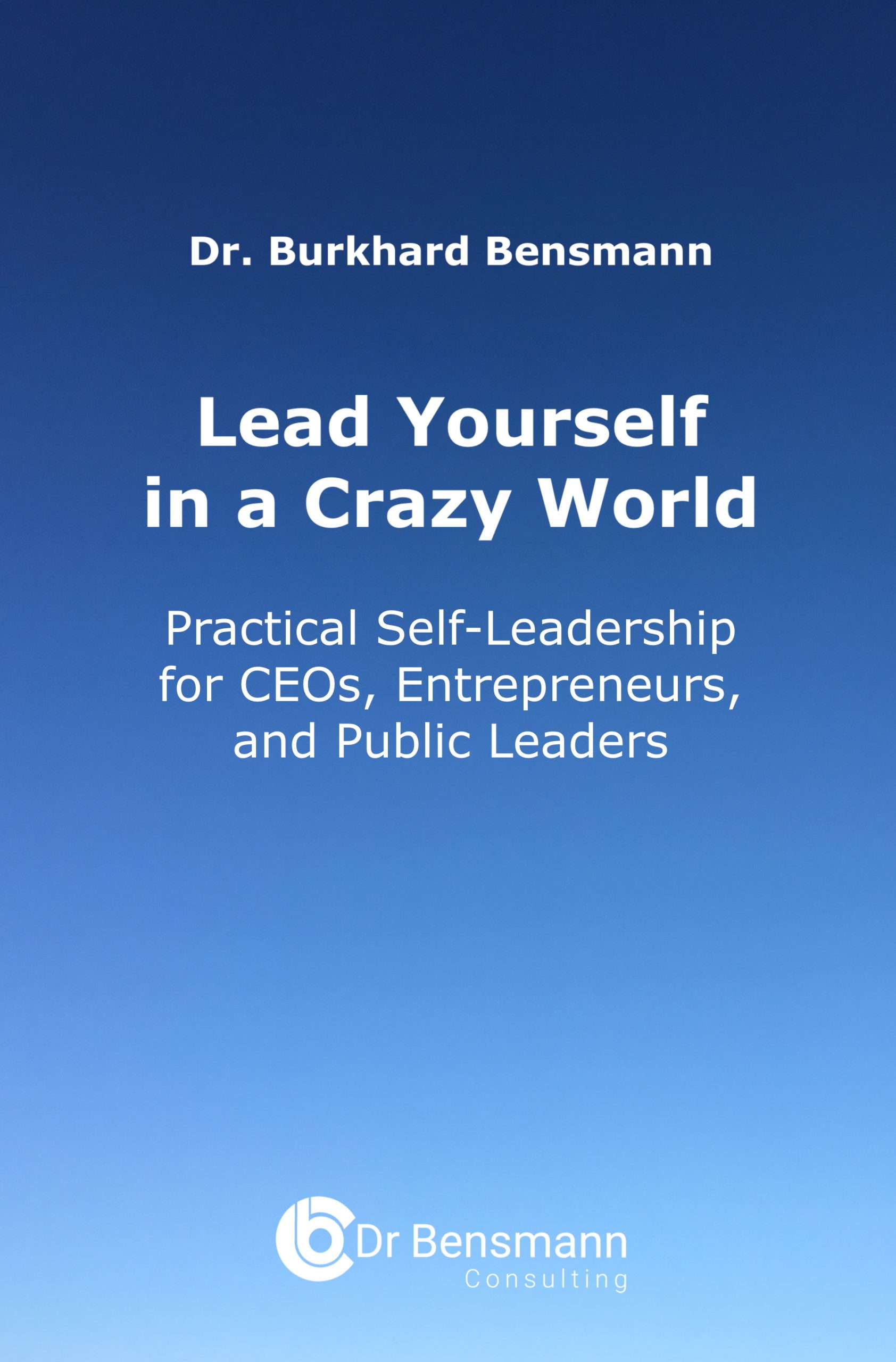
By the way: Because of this topic, I wrote a new, very compact book in English around the turn of the year.
Title: Lead Yourself in a Crazy World. The suggestions here refer to the content of the book—where I add to them and go deeper. At the end of the podcast, I’ll share a brief note about it.
So—let’s get to the topic of this episode: Focus instead of constant stress.
Why this matters right now
Many leaders experience this already before 9 a.m.: emails, chats, groups, news, internal issues—and before the “real work” even begins, the mind is already full.
On top of that: content has not only become more complex—it has become harder to assess, because AI can generate text, images, audio, and video that look authentic. From my perspective, 2026 will be the year when deepfakes become a central problem.
So the first building block I want to talk about is: Protect your mind—because attention is a strategic resource.
The second: Create a simple trust filter that keeps you capable of acting.
And the third: Become a conscious user of AI—with smart use and necessary boundaries.
Let’s start with the first one.
1) Protecting attention: Your focus rules
What it is
“Focus rules” are your personal, deliberate set of rules for when information is allowed into your awareness—and when it isn’t. They define how you deal with emails, chats, news, and meetings so you can reliably regain thinking time for what matters.
The point is not to get less input, but to regain control over timing and channels.
Why it matters
If your day consists of dozens of interruptions, you don’t just lose time—you lose mental space for strategic decisions.
And that’s exactly what leaders are paid for: setting priorities, giving orientation, making decisions that hold up.
Reflection question
When during the day is the mental noise strongest for you—morning, afternoon, evening? And what creates it: meetings, email, messenger, news, social media?
Practical impulse: Three rules that work immediately
- Two to three fixed email windows per day instead of constant reacting.
- One 60–90 minute focus block every day—notifications off, no parallel channels.
- Meeting discipline: no phones on the table when strategic decisions are being discussed.
And if you want to test this: not as a new big project—but as an experiment.
Now let’s move to the second building block.
2) Trust filter: Decide what you believe—before you act
What it is
You don’t need perfect certainty. You mainly need a practical filter that answers the question:
“Does this information deserve my attention—and possibly an action?”
Why it matters
Deepfakes and coordinated disinformation attack trust—in people, institutions, markets. (Or they build on distrust.)
And in day-to-day leadership, one false trigger is enough to set off unnecessary escalations—internally or externally.
The 3-question filter (short, but effective)
Before you forward or react to critical information:
- Who benefits if this is believed?
- Can I verify it—at least via one independent source?
- What would be the consequence if it’s wrong?
Reflection questions
Think of three “critical pieces of information” (articles, claims, social media posts) from the last six months that influenced you.
Could you verify them independently—or did you rely on gut feeling?
Were you drawn more to negative news?
What feelings did these pieces of information trigger in you?
(Media diet!)
Key line: Don’t believe everything you think! (Source unknown…)
Practical impulse: Source minimalism
For global topics and your industry, choose three to five high-quality sources—and decide deliberately which “rumor channels” you consistently ignore. (That came up recently in a conversation with an acquaintance.)
It sounds simple—but it reduces complexity.
3) Partnering with AI: Reflective instead of reactive
What it is
AI is not only a technology topic. It changes trust, decision quality, and the personal risk profile of leaders.
Many experience curiosity and overwhelm at the same time—and then slip into two extremes: tech hype or tech avoidance.
As I mentioned earlier: part of my coaching system for top leaders are my AI impulses—tailored by me to the needs of my clients.
Why it matters
You don’t need to become an AI engineer. But you do need a clear, reflective relationship with AI in your role.
Otherwise, tools and expectations will push you around—and that’s again reaction mode.
Three concrete approaches
- Clarify your AI stance (green / yellow / red).
- Green: Where does AI support your thinking—concepts, research, learning, planning?
- Yellow: Where do you test carefully?
- Red: Where does it remain deliberately human-only (e.g., sensitive feedback, political judgments, values-based decisions)?
- Minimal cockpit instead of a tool circus.
Choose a small set of tools you truly understand and use consistently—instead of constant switching. - Cyber hygiene as self-leadership.
Leaders are attractive targets. Treat voice and image as assets that can be misused—and define rules for critical instructions.
One immediately actionable example: for unusual financial or strategic requests, require verification via a second channel (phone / in person / independent channel).
Reflection question
Which task in your daily work would you most like to support with AI—and which would you never hand over because it is too sensitive?
Micro-rituals: Clarity in the noise of the day
Many underestimate the impact of small routines that bring your inner control center back online.
Three examples that have proven effective in practice:
- 5-minute evening journal: “What was truly important today—and what was just noise?”
- Decision logbook with questions like: What do I know, what am I assuming, what are my criteria?
- 5-second pause in an important conversation before you respond: breathe briefly, then clarify: “What outcome do I want with my answer?”
Call to action
And yes—I want to come back to my new compact English book Lead Yourself in a Crazy World.
Because developments—especially in the AI context—are currently moving so fast, I published the book quickly. It’s still “warm.” You can find it on Amazon as an ebook and in print. I’ll put the link in the show notes. The book includes:
- Five focused chapters on the central challenges leaders face today.
- A practical self-leadership toolbox (Mission, Vision, AI radar, media diet, planning days, mental immune system).
- A compact overview of the Seven Fields of Self-Leadership—as a framework for regular self-checks and continuous development.
Closing
Self-leadership in the age of AI does not mean exposing yourself to every influence uncritically. It means protecting your attention, filtering information better, and using AI consciously as a tool.
Thank you for tuning in to *Self-Leadership with Dr. Bensmann*. My mission is to empower leaders like you to not just survive, but thrive.
If this episode was helpful, feel free to share it with someone who also wants “focus instead of constant stress.”
And before you move on: write down one small step you will truly implement this week—so insight turns into practice. Until next time, stay strong and lead yourself well!
Yours, Burkhard Bensmann.
The New Compact Book
Purchase
as ebook
or print version here.
Music Intro & Outro by Joakim Karud http://soundcloud.com/joakimkarud


